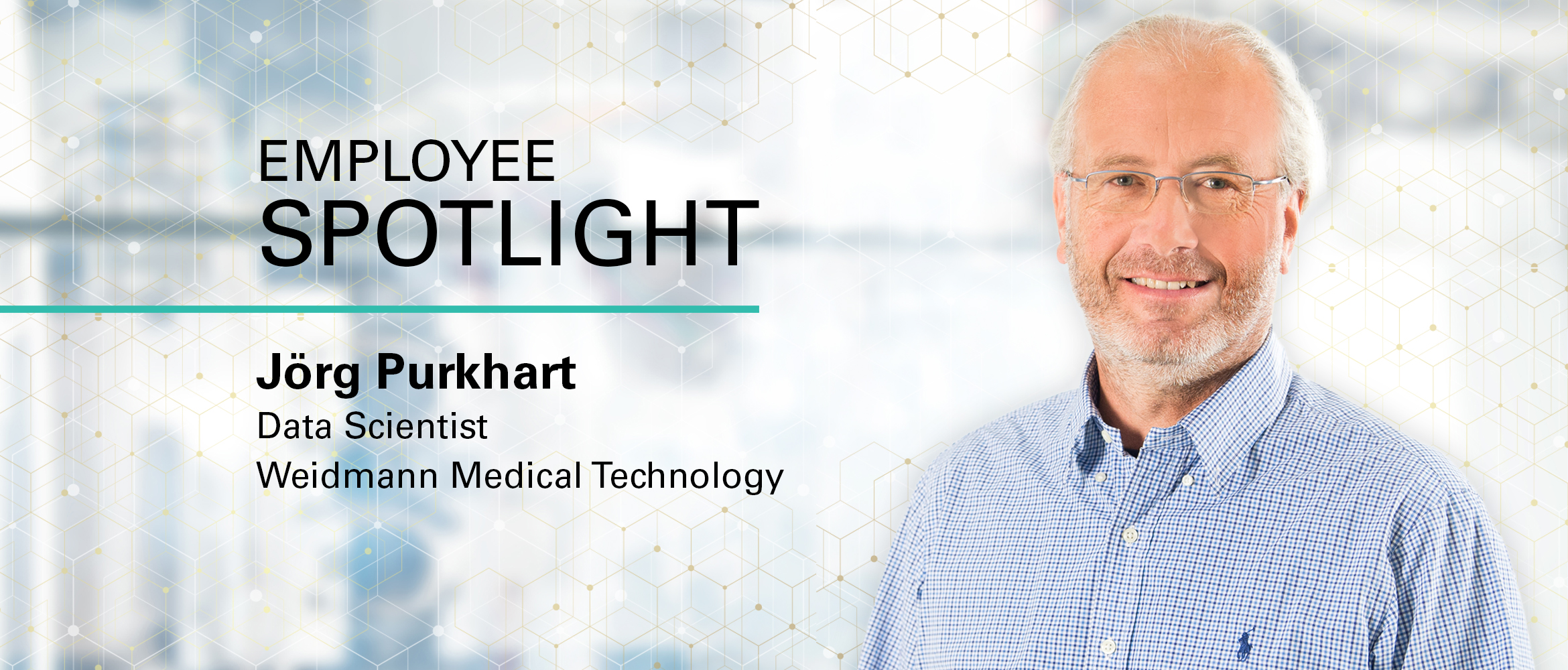
Employee Spotlight: Jörg Purkhart
Hello, Jörg. Could you please introduce yourself in a few sentences?
My name is Jörg Purkhart. I am a data scientist at Weidmann Medical Technology.
I studied data technology and forestry, and later specialized in geomatics and statistics. Complemented by further training in Six Sigma and artificial intelligence, I now combine computer science, statistics, data analysis, and process understanding in an industrial setting.
How did you get into medical technology?
My path led me through cartography, aerial and satellite image analysis, and measurement image analysis of highly advanced optical inspection systems in the pharmaceutical industry, to measurement technology and data analysis in the medical plastics industry.
I am particularly drawn to the fact that, thanks to advancing digitalization, more high-quality data from production facilities and product quality data is becoming available. With this potential, suitable analytical methods, optimizations, and improvements are possible for both the customer and Weidmann Medical. The challenge lies in the enormous volume of data, which can now only be processed using statistical methods.
What exactly does your role at Weidmann Medical entail?
I work at the interface between pharmaceutical customers, Weidmann Medical, and suppliers, in both production and quality. Analyzing complex data creates a solid basis for decision-making for all stakeholders. My main tasks specifically include developing data models for the digitization of processes, continuing to develop measurement and testing systems, applying statistical methods and AI, and implementing Six Sigma projects for process optimization.
What is the concrete added value for our customers?
Our customers are under significant pressure to demonstrate stable processes and the highest quality products and services. Through data-driven analyses, we can detect process fluctuations early on, systematically identify the causes of deviations, and adapt production processes to be more robust and efficient. Ultimately, this yields greater certainty, lower risk, and reliable scaling in mass production for the customer.
Can you give a real-world example?
A typical example is the analysis of measurement data from production. Here, it’s not just about recording values, but about recognizing patterns:
- Where do deviations occur?
- Are they random or systematic?
- Which parameters influence quality?
Using statistical models, we can visualize these relationships and make targeted improvements. This reduces scrap, stabilizes processes, and increases predictability.
What role does data analysis play in a regulated environment?
In the medtech and pharmaceutical sectors, data quality is critical. Statistical analyses form the basis for process validations, demonstrations to customers and regulatory authorities, and informed decision-making.
The better the data is structured and analyzed, the clearer and more reliable the results are.
How are data science and AI transforming production?
We are seeing a clear shift toward more data-driven and increasingly AI-supported processes. Data is documented and actively utilized for the early detection of deviations, optimizing process parameters, and continuously improving quality and efficiency.
Artificial intelligence opens up additional possibilities, particularly when dealing with complex relationships and large volumes of data. For example, in automated pattern recognition in production data, predicting process behaviors, and supporting real-time decision-making processes.
The goal is not to replace humans, but to make decisions more reliable and processes more robust.
What personally motivates you in your work?
What motivates me most is that my work has a direct and measurable impact. When data helps make processes more stable or improve quality, you can very clearly see what has been achieved. This combination of theory and practical application makes the work particularly exciting.
What do you do in your free time?
I love being outdoors—in the winter, I enjoy skiing, ski touring, and ice skating; in the summer, I switch it up for mountain biking and hiking.